
Personalize your takeaways & insights with AI





Introduction
If you are a leader in the insurance industry, you know the sinking feeling that comes with an Errors and Omissions (E&O) scare. It usually starts with a phone call from a confused client. Then, you pull the file, check the emails, and check the AMS. And there it is: a gap. A missed endorsement, a transposed number, or a checkbox left unchecked.
The immediate reaction in most agencies is predictable. They hold an emergency meeting and emphasize the importance of “double-checking” work.
Often, agencies treat E&O as a behavioral issue: a lack of effort or attention to detail. However, in reality, your account managers are not careless. They are operating in a high-volume, high-complexity environment.
The root cause of E&O risk is not “bad luck” or “inefficient employees.” It is a process failure. It is the inevitable result of asking humans to behave like machines.
To truly mitigate E&O risk, we have to stop treating symptoms and start treating the root causes. This is where intelligent insurance workflow automation shifts from being a useful productivity tool to a vital layer in risk management.
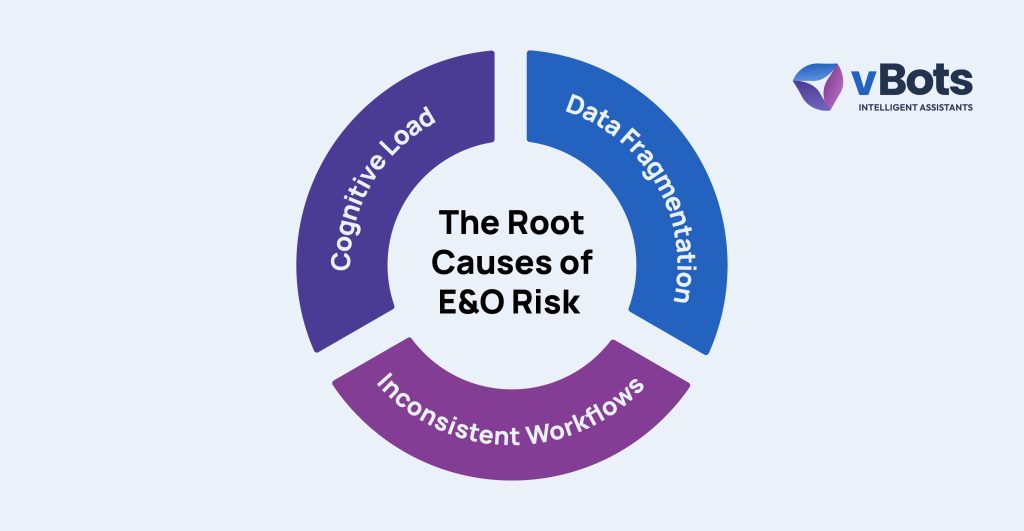
Root Cause 1: The Cognitive Load and Fatigue
Let us consider a standard policy renewal season. Your team handles hundreds of policies. For each one, they need to compare the renewal quote against the current policy to identify changes in premium, deductibles, or coverage limits.
The first 5-10 policies get a rigorous review. The agent is fresh, alert, and focused. But what about the 50th policy?
This is cognitive load. The human brain is not designed for repetitive, high-stakes data comparison over long periods. As the volume of work increases, our ability to spot anomalies decreases. We start to glaze over. We succumb to alert fatigue, where subtle changes in a policy document blend into the background noise. This is where manual spot-checks fail.
The Intelligent Automation Fix
Insurance workflow automation changes the game entirely. An intelligent assistant does not suffer from fatigue. It reviews the 500th policy with the same precision as the first policy.
By automating the policy renewal process, the risk of tired eyes missing a crucial detail vanishes. This elevates the renewal process and allows your agents to move away from manual data checking and focus on professional advisory and relationship building.
Root Cause 2: Data Fragmentation and “Swivel-Chair” Problem
Insurance is an industry of fragmented data. Your truth lives in the AMS, but the carrier’s truth lives in their portal. The bridge between these two worlds is a human performing “swivel chair” operations: switch tab, copy, paste, repeat.
Every manual copy-paste is a micro-opportunity for data errors.
Consider this scenario: An agent retrieves a policy document from a carrier portal. They download the PDF, rename it, drag it into the AMS, and manually update the policy details.
If the agent is interrupted by a phone call from a client regarding a COI or a policy endorsement in the middle of that sequence, or if they mistype , the data in your AMS no longer matches the reality of the carrier’s coverage. If a claim occurs and your team advises the client based on the incorrect data in the AMS, you have a defenseless E&O case on your hands.
The Intelligent Automation Fix
Insurance-specific automation solves this data fragmentation problem. Intelligent assistants eliminate the data entry variable. The document is indexed correctly every time. The policy details in your AMS match the details in the carrier portal.
Root Cause 3: Inconsistent Workflows
- Agent A might send an email to the client immediately and record the activities in the AMS.
- Agent B might leave a sticky note on their desk to follow up with the client later.
This Ad-hocism, where processes vary by individuals, is a breeding ground for omissions. If Agent B takes a leave, and the sticky note gets thrown away, the client’s policy might lapse without them realizing it. When the client mentions they were never properly notified, the agency’s defense collapses because there is no auditable trail of action.
The Intelligent Automation Fix
Automating insurance workflows enforces standardization. Automation cannot decide to skip a step because it is too busy.
Consistency and audit-readiness are your best defense against E&O scares, and automation creates auditability by default.
The “Invisible” Benefit
There is a final, often overlooked way that automation reduces E&O risk. It is less about data entry and more about what your agents are not doing.
A significant percentage of E&O claims stem from “failure to recommend coverage” or “failure to explain exclusions.” These errors happen when agents are rushing.
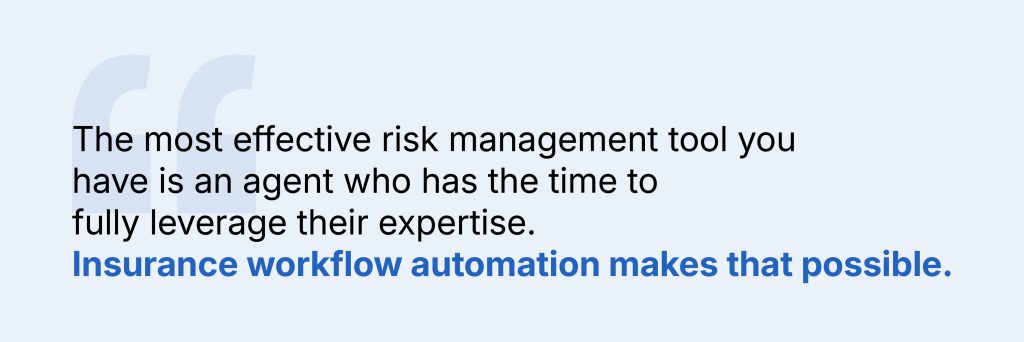
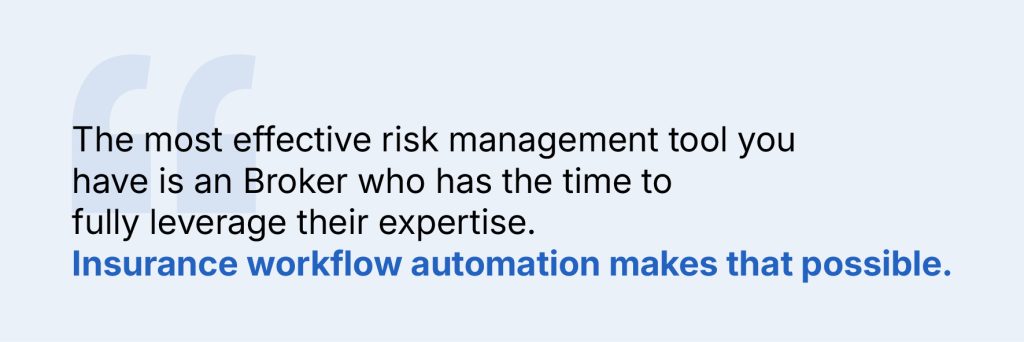
By delegating repetitive work to automation, you reclaim your team’s valuable time. You give them the time to pick up the phone, walk the client through their exclusions, and recommend suitable coverage.
Conclusion
We have to stop looking at E&O claims as inevitable accidents and start seeing them for what they are: fragile, manual workflows.
You cannot train your team out of cognitive fatigue or data entry errors.
Intelligent automation solutions from vBots offer a way to fortify your agency. It ensures that 100% of policies are checked, that data moves between systems without errors, and that critical workflows like NOCs execute the same way, every single time.
Do not wait for the next E&O scare to reveal the cracks in your process. Contact vBots today to see how our intelligent bots can audit-proof your operations and let your team focus on what matters most: serving your clients.
Frequently Asked Questions
Share this article