
Personalize your takeaways & insights with AI


Many insurance brokerage leaders have been in the same conversation at some point. Someone on the team suggests using a generic AI tool to accelerate a workflow. It sounds reasonable for the following reasons: The tools are accessible, constantly improving, and the initial demos look impressive. However, as time goes on, the problem shows up when the output needs to be verified, corrected, re-entered, or explained to a regulator.
Generic AI tools were built to be broadly capable. In a regulated environment like insurance, broad capability without domain context creates more risk than it removes.
The Mismatch - What Generic AI Gets Wrong
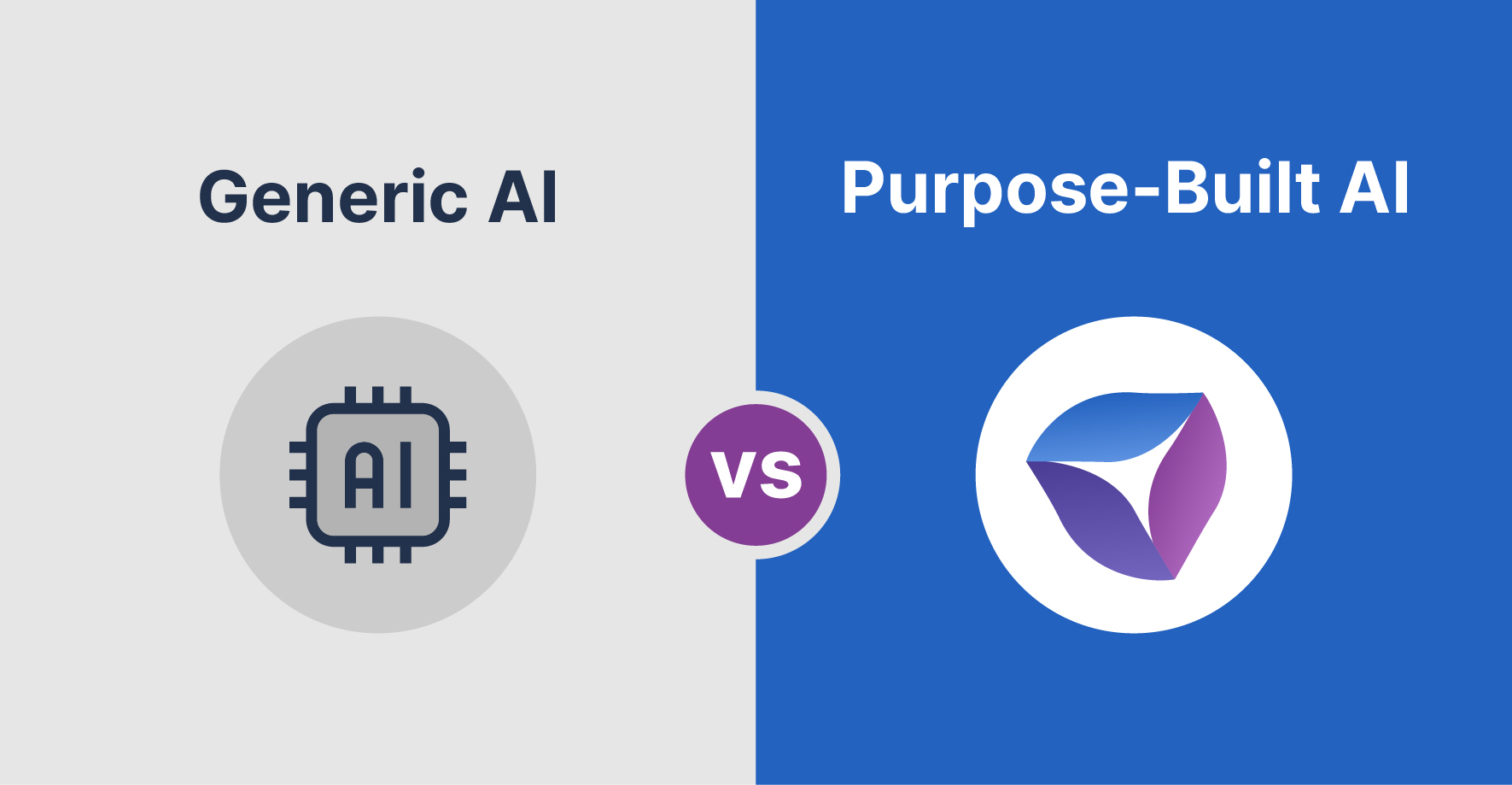
General-purpose AI tools are trained on a wide range of data and optimized for general tasks: summarizing documents, drafting emails, and answering questions. When you look at industry-specific AI vs general AI, the contrast is sharpest in regulated environments.
Generic tools do not carry any built-in knowledge of how an BMS is structured and how carrier portals behave. The consequence is that generic AI tools produce outputs that look right but aren’t. In insurance operations, this gap gets filled by human review. A CSR still has to check the output, validate it, and manually re-enter any data that needs to go into the BMS. The tool removed some of the reading work but left most of the operational burden in place.
Regulatory frameworks and compliance requirements set a high bar for how AI should behave in insurance contexts. Generic AI tools are not designed with insurance-specific accountability or audit trail requirements in mind.
What Purpose-Built Actually Means
The phrase gets used loosely in AI marketing, so it is worth being precise about what it actually describes.
A purpose-built AI-automation system is one in which the underlying logic, data model, and workflow design are built around a specific domain. It is not a general model with a custom prompt layer on top. The domain knowledge is baked into how the system reads data, validates outputs, and decides what to do next.
A purpose-built insurance automation solution already knows what a valid endorsement change looks like in the context of a specific policy record. It already understands how to navigate a carrier portal, what fields need to be updated in the BMS, and what a complete, logged transaction looks like. The decision logic is not inferred from a general model. It was designed for the task.
That is the standard vBots was built to meet. Every intelligent assistant we deliver is developed around the actual workflows P&C agencies run, with native BMS integration, carrier portal connectivity, and audit-readiness built in from the start.
Where the Gap Shows Up in Real Operations
Three workflows that illustrate the difference clearly.
Endorsements processing is a good starting point. A generic AI can read an endorsement request from an email and extract the key details. What it cannot do is validate those details against the existing policy record in the BMS, apply the change to the correct fields, and log the action with a traceable record. vBots handles all three steps as a single connected sequence. The CSR receives confirmation that the change was applied correctly, not a draft that still needs to be checked.
Direct bill reconciliation is another area where the limits of generic AI become visible. Matching carrier commission statements against agency records requires understanding insurance accounting logic, knowing which variances fall within acceptable thresholds, and flagging exceptions for human review in a way that’s actionable. A general tool can produce a comparison. A purpose-built assistant produces a reconciled output with variances identified and categorized. The difference in downstream work is significant.
Notice of cancellation monitoring is another area insurance-specific automation earns its place most clearly. A generic tool might summarize a NOC document after someone uploads it. vBots monitors carrier portals continuously, downloads NOC documents as they appear, validates the contents, records them in the BMS, and triggers the appropriate team notification.
The Real Cost of Choosing the Wrong Tool
Brokerages that deploy generic AI for operational tasks do not eliminate oversight. They shift it. Someone still has to review outputs, catch errors, and manually handle anything the tool could not process reliably. The productivity gain is partial along with the E&O exposure. The total cost of the workflow, including staff time spent checking AI outputs, is often not meaningfully lower than before.
The benefits of purpose-built AI for insurance brokerages show up precisely here. Purpose-built automation reduces both the error rate and the supervision burden because the logic was designed for the specific task. Across the brokerages that use vBots, that compounds into measurable results:
- 10,000+ hours saved
- $3M+ million in annual cost savings
- 100,000+ transactions processed every month
Those numbers reflect what happens when automation handles a task correctly the first time rather than producing a starting point for human review.
The Choice Every Agency Will Make
AI adoption in insurance operations is no longer a question of if. Every agency will automate some portion of their workflows. The relevant question is whether the tool they choose actually understands the work.
General-purpose AI helps an agent write a better email or pull a quick summary. Purpose-built insurance AI makes operations more reliable. For agencies where policy accuracy, compliance, and efficiency determine the bottom line, productivity without reliability is a partial win. The goal is not just faster work. It is work that does not need to be redone.
If you want to see how vBots handles your specific workflows, we will be glad to walk you through it. Schedule a conversation with our automation experts!
Share this article