
Personalize your takeaways & insights with AI




Introduction
- Someone is pulling documents from carrier portals.
- Someone else is manually entering the same data your AMS should already have.
- A CSR is chasing down a policy detail for the third time this week.
And meanwhile, the work that actually grows your agency: new business, renewals, client engagement and relationship-building keeps getting pushed to the end of the queue.
This is the operational reality for most insurance agencies. And it is the exact problem insurance-specific automation is built to solve.
But here is what agencies often overlook: getting the technology right is only part of the equation. How you manage the transition from your current workflows to AI-assisted ones determines whether the investment pays off.
AI adoption becomes imperative because...
Insurance agencies run on defined, rule-based processes. Document retrieval, data entry, policy management, reconciliation, quote generation all of it requires precision, and most of it has required a person sitting in front of a screen to handle it.
The result? Your licensed, experienced agents spend a significant portion of their time doing work that does not require their expertise. Data entry errors still happen. Turnaround times lag. And the operational load keeps growing as your book of business grows.
Automating these high-volume, repetitive tasks with AI shifts the scene. Your team’s attention moves from doing repetitive tasks to value-adding tasks like client engagement, relationship management, cross-selling, and up-selling. The tasks that once consumed hours get handled faster, with greater consistency and higher throughput. And the people you hired for their judgment and client skills get to actually use those skills.
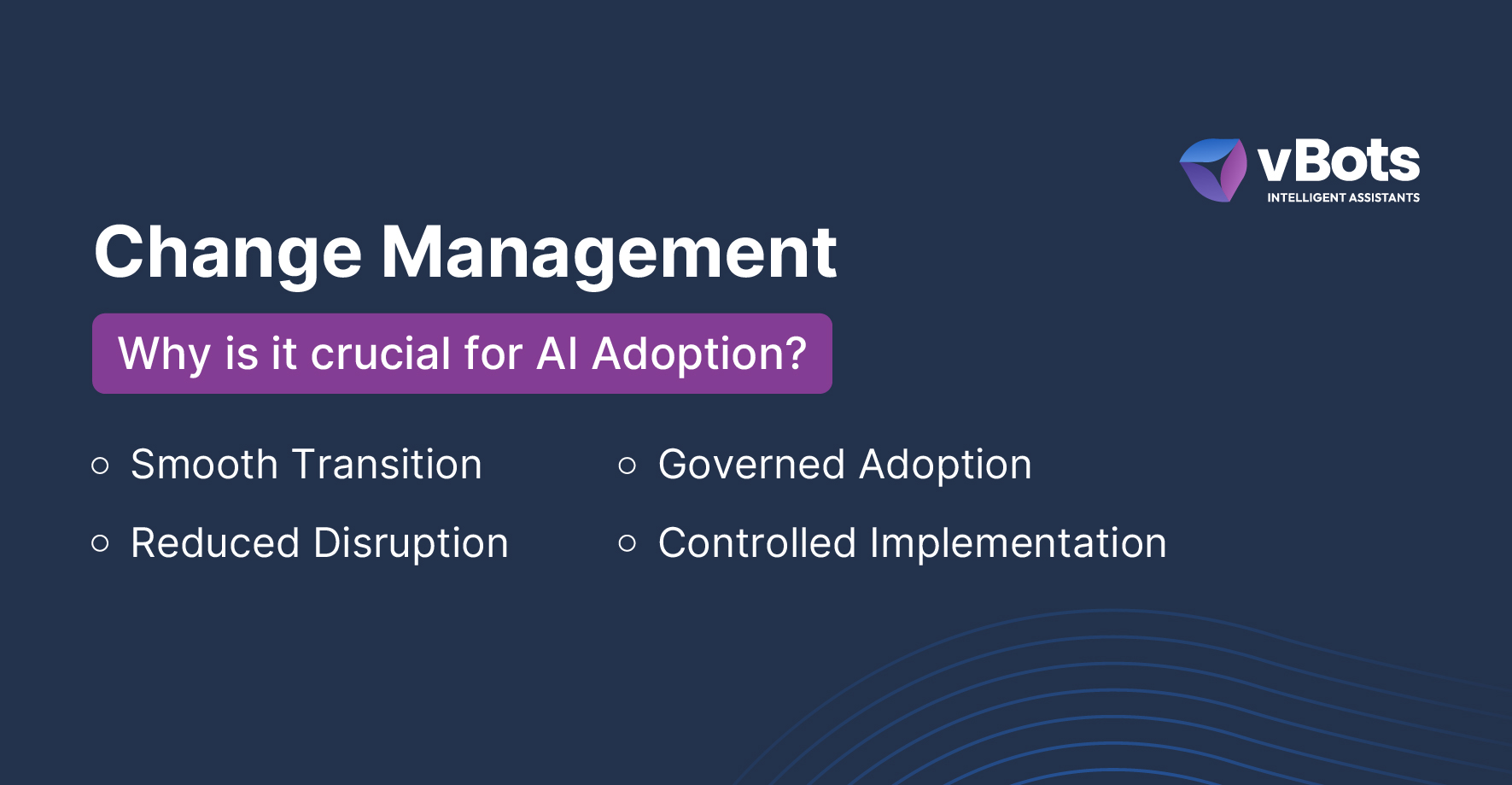
Change Management becomes the bridge
AI can improve your operations. But without a structured approach to implementing it, even the best automation tools underdeliver.
When agencies decide to adopt AI, three questions tend to come up almost immediately:
- Which workflow should we automate first?
- How do we prepare our team for this shift?
- How do we roll it out without disrupting what is already working?
These are the right questions. Your agency follows defined processes, and your team has built their workflows around those processes. Introducing AI into that environment without a plan creates friction, confusion about roles, gaps in accountability, and staff who are skeptical rather than bought in.
Change management bridges that gap. It gives your team answers to the questions they are already asking:
What is changing? Manually repeated, process-heavy tasks are being taken over by AI.
Why is it changing? Automation takes care of recurring, detail-intensive tasks like manual data entry, policy checking, AMS updates, etc. So, your team can focus on work that contributes to agency growth such as proactive account reviews, personalized client engagement and growth strategies, that actually requires human intelligence.
How will it affect their day-to-day performance? Their workflow becomes more governed and more focused on the work that actually moves the needle.
What support will they have? A structured, expert-guided rollout from day one with clear milestones and ongoing support.
Change management ensures that what you adopt actually sticks. It makes the transition intentional, organized, and centered on the people doing the work.
What Happens With and Without Change Management?
When AI is introduced without a structured change process, a few things might not work as expected:
Resistance from your team. Without clear communication, people assume automation means replacement. That fear quietly kills adoption.
Confusion about how to use it. AI tools are only effective if people know how to work alongside them. Without proper training, usage drops off, and the technology sits underutilized.
Missed ROI. Agencies that do not manage the transition often end up with a tool that never reaches its potential or one that gets quietly abandoned after a rocky rollout.
With effective change management in place, the story is different:
Your team will adopt it. When people understand what the tool does, how it helps them, and what their role looks like alongside it, adoption follows naturally.
Operations stay stable. A phased, well-communicated rollout means daily workflows continue without disruption while the new system is brought online.
You reach your goals faster. Burnout drops. Efficiency goes up. And the operational capacity you freed up gets redirected to where it matters most.
What Effective Change Management Actually Looks Like
1. Planning the Change – Identify which workflows to automate and in what order. Define what success looks like. Assess where the risks are before implementation begins.
2. Communication – Your team should hear about this before it happens, not during the implementation. Explain what is changing, why it is changing, and what the timeline looks like. Make room for questions.
3. Stakeholder Engagement – Bring in employees, team leads, and decision-makers early. When people have a voice in the rollout, resistance drops and ownership goes up.
4. Training and Support – Give your team the knowledge to use the tools confidently. This is not a one-time session; it is an ongoing resource as workflows evolve.
5. Implementation – Roll out in phases rather than all at once. Monitor what is working, catch what is not, and adjust before expanding.
6. Review and Reinforcement – Measure outcomes against the goals you set in step one. Recognize what is working and build on it.
How vBots helps?
vBots builds secure, governable AI assistants specifically for insurance agencies. Our intelligent assistants are SOC2 Type 2 compliant and operate within the regulations of the insurance industry.
When your agency works with vBots, you get expert guidance on where to start, how to sequence the rollout, and how to manage the change, so your team lands on the other side of implementation confidently.
The result: Your team’s time shifts toward the roles you actually hired them for instead of getting stuck in a loop of repetition.
Conclusion
Implementing AI is a decision. Making it work is a process.
The agencies that see the biggest returns from AI adoption are the ones that invest in change management. When the transition is planned, communicated, and supported properly, your team does not resist the change; they see the value of it.
At vBots, our automation experts help you identify where to start, guide you through adoption, and make sure the change AI brings to your workflows actually holds.
Ready to figure out where your agency should start with automation? Talk to our experts.
Frequently Asked Questions
Share this article