Personalize your takeaways & insights with AI





Ask anyone who manages policies what takes up most of their day, and the answer is rarely one major task. It is usually a series of repetitive steps across renewals, document retrieval, policy checking, endorsements, and client service.
A renewal can need information and documents pulled from several systems before it moves forward. An endorsement request can sit in an inbox until someone reviews the details and enters the changes into the AMS. A policy often needs to be compared against a quote or proposal before it goes out to the client.
As the number of policies increases, the time and coordination needed to manage these tasks grow as well.
What Can Policy Management Automation Include?
Policy management workflow automation streamlines the steps involved in receiving information, retrieving documents, validating details, updating records, and routing exceptions for employee review. Instead of automating isolated tasks, it helps agencies keep the entire process moving across their existing systems.
Intelligent Document Retrieval Automation
For policy work to move forward, employees need quick access to the correct documents. A renewal, an endorsement, or a client question can all stall out if someone has to go find the paperwork first.
This usually means logging into carrier portals, searching for the right file, downloading it, renaming it, and attaching it to the correct policy record manually. Repeated across every carrier and every policy, this becomes one of the more time-consuming parts of the day, and it only gets slower as a book of business grows.
AI-powered automation can monitor designated sources, access carrier portals, locate requested documents, and attach them to the correct record in the AMS automatically. When something needs a closer look, it creates an activity and notifies the right team member.
Intelligent Renewal Automation
Renewal processing means monitoring expiration dates, retrieving documents, comparing policy details, updating records, communicating with clients, and following up on missing information. When handled manually, these steps must be repeated for every policy approaching renewal, increasing the time and effort required as volumes grow.
Renewal automation can identify policies approaching renewal, retrieve documents from carrier portals and other designated sources, extract policy information, and compare current terms against existing agency records. Based on the approved workflow, it can update renewal details in the AMS and send predefined communications to policyholders.
Intelligent Policy Checking Automation
Before a policy is issued to the client, employees need to confirm that it reflects the coverage, limits, forms, and premiums documented in the quote. Checking that manually means comparing documents line by line, and small differences in coverage can be easy to miss, especially under time pressure.
Policy checking automation can extract information from policy documents and compare it against AMS records, quotes, or proposals. Any differences it finds get summarized in a discrepancy report and routed to the right employee. This gives employees a clear view of exactly what needs their attention.
Intelligent Endorsement Automation
Endorsement requests can arrive through client emails, carrier notifications, attachments, or carrier portals, all at once. Someone must review each request, identify the right policy, validate the requested change, and update the record.
Managing endorsement requests alongside renewals and new business requires significant time and attention from agency staff, increasing the potential for processing delays.
Endorsement Automation can monitor incoming sources, extract details like the policy number, effective date, coverage changes, and premium adjustments, and validate the information before updating the correct record. Complex requests get flagged and routed to the right team for review.
Intelligent Notice of Cancellation Automation
Carriers may issue a Notice of Cancellation (NOC) for nonpayment or other policy-related reasons. Each notice includes an effective date by which the agency may need to act.
When handled manually, employees must monitor notices across carrier portals and inboxes, review the reason for cancellation, and follow up with the client before the deadline. If a notice is missed or addressed too late, the policy could lapse unintentionally.
NOC automation can retrieve cancellation notices from carrier portals, designated inboxes, and other sources, then send automated payment reminders to clients on scheduled follow-up dates to help prevent the cancellation altogether. It can also monitor designated sources for reinstatement notices and attach them to the appropriate policy record.
Although each workflow addresses a different policy management challenge, they rely on the same operational foundation: consistent validation and recordkeeping, clear exception handling, and timely communication.
Benefits of Insurance Workflow Automation
Workflow-level automation can help agencies:
- Spend less time retrieving documents and updating policy records
- Manage renewals, endorsements, and policy checks more consistently
- Keep policy documents and activities connected to the correct records
- Catch discrepancies and exceptions that need employee attention
- Support timely communication with clients and internal teams
- Reduce repeated data entry and routine administrative work
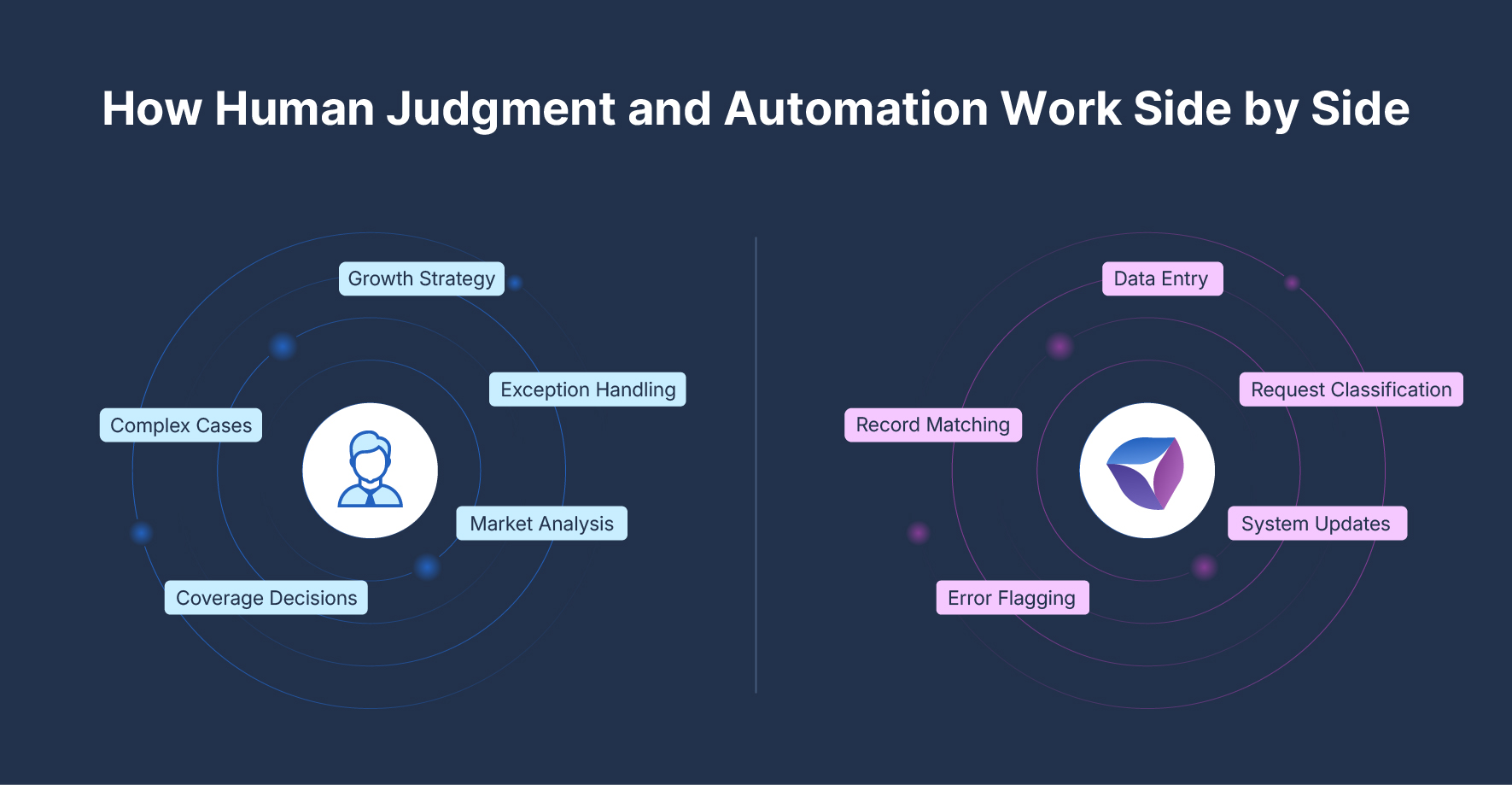
- Give employees more time for policy review and client service
By connecting activities across carrier portals, email inboxes, the AMS, and other designated sources, agencies can keep routine work moving while directing exceptions to the right team.
Where Could Automation Support Your Agency?
Every agency runs differently, with its own systems, carriers, and internal procedures. A useful first step is identifying where to start with automation.
vBots helps agencies automate policy management workflows, including document retrieval, renewals, policy checking, endorsement processing, and NOC handling, across the AMS, carrier portals, email inboxes, and other designated sources.
Conclusion
Policy management requires the judgment and expertise of experienced employees. However, routine tasks such as retrieving documents, comparing policy details, and updating records do not need to consume their time. Automating these activities can help agencies manage growing policy volumes consistently while making better use of existing team capacity.
Curious where these opportunities exist in your own agency? Take the Signs to Automate Assessment to see where automation could make the biggest difference.
Share this article