
- Published on: February 10, 2026
Introduction
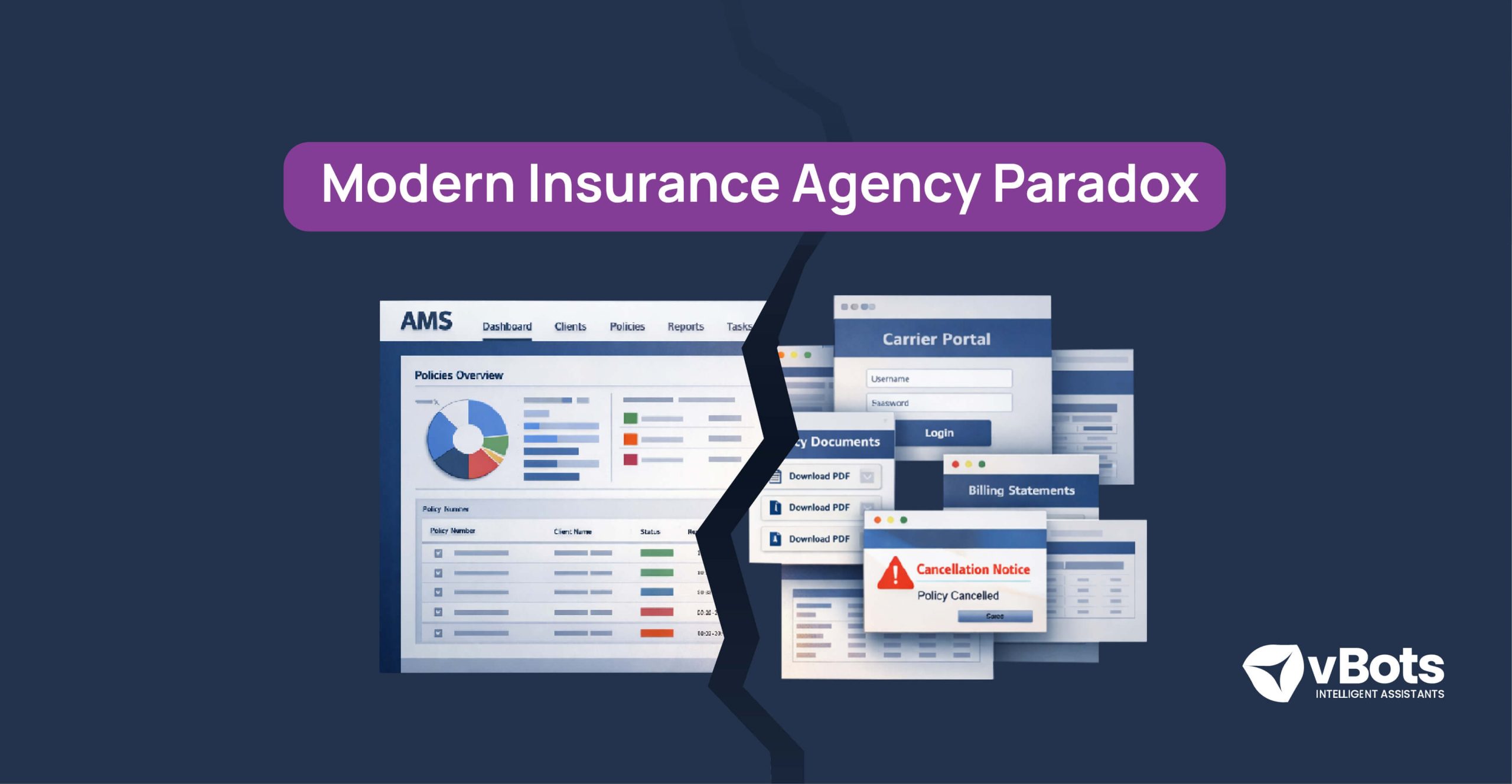
There is a paradox in the modern insurance agency. You have likely invested in a top-tier Agency Management System (AMS), such as Applied Epic or AMS 360. On the other side of the equation, insurance carriers have spent significant capital in developing robust, feature-rich online portals.
On paper, your insurance agency is fully digital. Yet, if you check your team’s activity log, you will see a different reality. You will see Account Managers manually copying data from a carrier website and pasting it into the AMS. You will see your team logging into several different sites just to verify a simple policy renewal.
Insurance agencies have better software than ever before, yet teams are more exhausted by administrative friction than ever.
The problem is not your AMS or the carrier portal. The real issue is the invisible chasm between them. This is workflow fragmentation, and it is probably the single biggest leak in your agency’s operational efficiency.
What is Workflow Fragmentation?
Workflow fragmentation describes the operational disconnect between two critical systems.
In the current insurance landscape, the AMS acts as an internal system of records, while carrier portals operate as external, secure data repositories. Despite the digital maturity of both platforms, they often lack direct interoperability.
This disconnect forces a reliance on manual bridging. Insurance agency staff must manually extract information from one secure environment (carrier portal) and re-enter it into another (AMS). This manual workload is often overlooked as part of the job. However, this is not just a mere inconvenience; it is a structural deficiency.
The efficiency gained by using high-speed software is negated by the manual effort required to synchronize them.
The Blind Spots Your AMS Cannot See
Since your AMS cannot “see” outside its own database, it creates operational blind spots. These are areas where data exists, but your systems and reporting remain in the dark until a human intervenes.
Here are some blind spots in typical insurance agency operations:
Document Retrieval and Portal Hopping
Your AMS is excellent at storing documents, but it has no ability to automatically fetch them for you.
This is where “portal hopping” becomes an issue. Consider this scenario: A carrier issues a policy renewal document. That document sits on the carrier’s portal, and your AMS does not know it exists. To bridge this gap, a staff member must:
- Navigate to the specific carrier website.
- Pass through login screens and Multi-Factor Authentication (MFA).
- Search for the policy.
- Locate the specific document.
- Rename it according to your agency’s naming convention.
- Upload it to the correct client file in the AMS.
Multiply this activity by the number of policies you manage, and you are looking at hundreds of manual hours monthly spent on fetching information, instead of analyzing it.
The Reconciliation Fatigue (Direct Bill)
Most carriers provide commission statements in inconsistent formats, such as static PDFs, Excel sheets, etc. Your AMS is designed to track what you are owed, but it cannot automatically verify that the carrier’s payment matches your internal records.
This creates a significant blind spot. Because manual reconciliation is time-consuming, many agencies allocate resources to only check high-level totals. The individual line items where small variances occur often go unnoticed.
This forces agencies to choose between two negatives:
- Wasted Potential: Accounting staff spends days every month manually matching entries, a task that provides no strategic value to the business.
- Revenue Leakage: To save time, some agencies accept the carrier’s numbers as facts. Over thousands of policies, these small, untracked discrepancies can lead to thousands of dollars lost in commission revenue annually.
The Communication Blind Spot
This is where workflow fragmentation becomes an Errors & Omissions (E&O) risk.
When a carrier issues a cancellation notice (NOC) for non-payment or non-renewal, that information usually resides within the portal or an email attachment. Your AMS has no way of knowing this status change until a staff member manually retrieves the notice and updates the AMS records.
The time lag between the carrier’s notice and the agency’s update creates a window of exposure. A client could call to file a claim on a policy that is being cancelled, and your staff member, looking at the “outdated” AMS, might assure them they are covered.
The Hidden Cost of Manual Intermediation
For years, agencies have solved these issues through manual intermediation. Agencies hire talented professionals and ask them to serve as data bridges.
When high-level thinkers are tasked with low-level data entry, agencies incur costs that go far beyond the payroll.
The Opportunity Cost
Every hour an Account Manager spends logging into portals is an hour they are not advising a client or solving a complex coverage issue. You are paying for risk advice, but you receive data entry. This misallocation of resources suppresses organic growth because your best people are too busy moving files.
The Scalability Ceiling
If your workflow relies on manual intermediation, your growth is capped by headcount. For instance, to generate 20% more revenue, you need 20% more staff to handle the data processing. True scalability requires the ability to increase volume without a linear increase in operational friction.
The Precision Gap
In a high-volume environment, the manual entry of effective dates, premium amounts, and policy numbers creates an inherent risk of data discrepancies. No AMS can self-correct a typo made during manual data entry. These small data errors compound over time, corrupting the integrity of your agency records.
The Solution: Intelligent Automation as “Connective Tissue”
The answer to workflow fragmentation is to build bridges that do not depend on manual data entry.
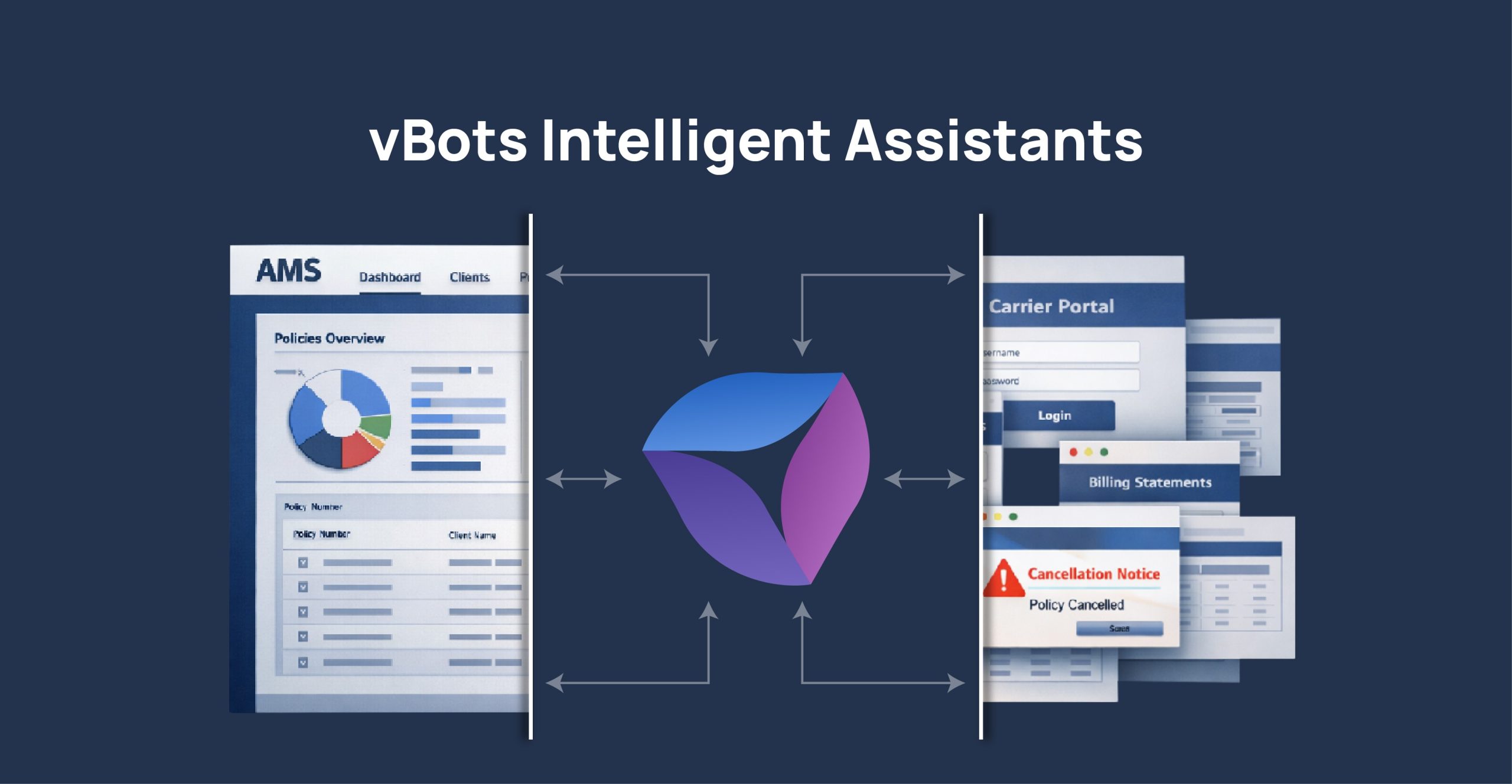
This is where intelligent, AI-powered automation enters the picture. vBots’ automation solutions, purpose-built for insurance operations, do not replace your AMS or the carrier portal; it acts as a “connective tissue” between them.
vBots offers a “intelligent workforce” that interacts with AMS and carrier portals exactly like a human does, but at machine speed and with precision.
- It Sees: Our bots can log in to carrier portals, navigate MFA security layers, and identify documents.
- It Reads: Using optical character recognition (OCR) and AI, our bots read and extract data from files.
- It Acts: Our bots can enter data directly into the correct fields in your AMS, attach the files, and create the necessary activities.
By deploying intelligent automation, you can eliminate the blind spots:
- Document retrieval happens automatically.
- Commission statements are checked down to the penny in minutes.
- Cancellation and renewal notices are sent to the policyholders without delay.
Conclusion: The Time to Act is Now
For too long, the insurance industry has accepted workflow fragmentation as the cost of doing business. But as margins tighten and client expectations rise, “manual bridging” is no longer sustainable.
Are you ready to un-fragment your agency’s operations? Get in touch with our experts today to see how our digital workforce can streamline your workflows.